


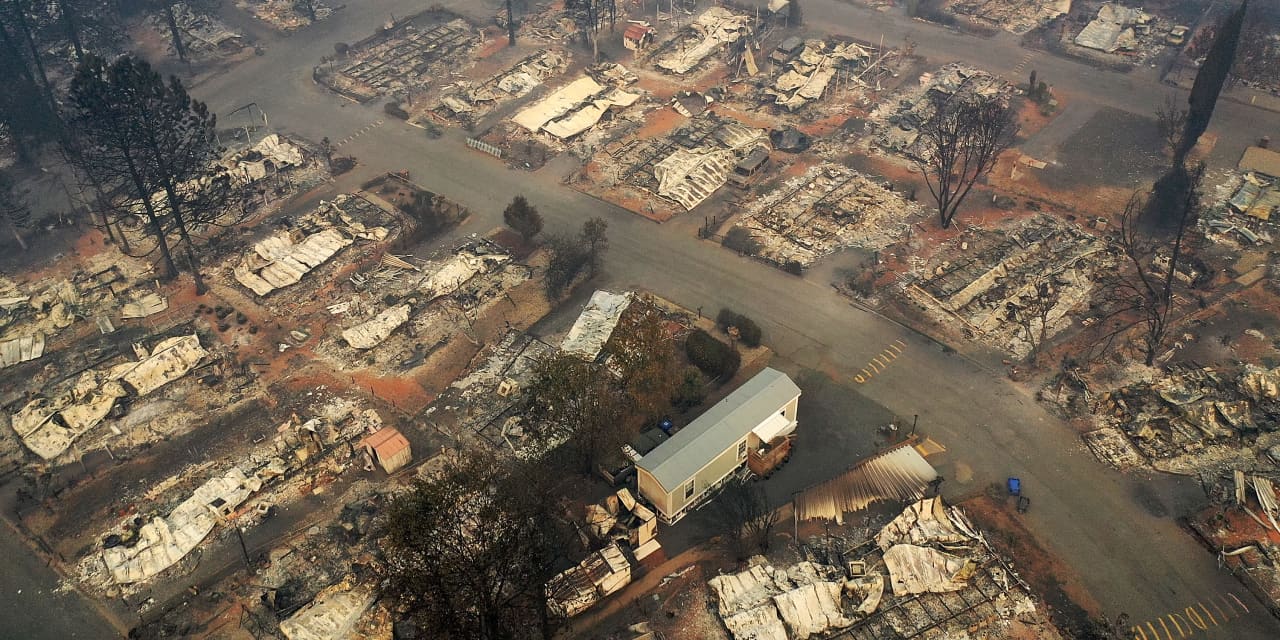
Three months ago, the redevelopment agency of Paradise, California—the town nearly wiped out by wildfires in 2018—missed payments for its municipal bonds issued in 2009. The funds were raised to develop the city’s commercial neighborhood and backed by incremental tax revenue from the areas. As economic losses from the fire drained the agency’s cash reserves and no new revenue came in, a default had been expected.
Debt default is uncommon for muni bonds, which are often viewed as a haven with steady, tax-exempt yields. Paradise’s example, however, is ringing alarms for a looming long-term risk from climate change: with more frequent and severe natural disasters, municipalities in vulnerable areas could see their economy disrupted, their asset values fall, and their tax base shrink—along with a deteriorating credit outlook.
While corporations can move their supply chains to safer grounds, cities and towns are tethered to their specific locations. Extreme weather events like hurricanes and wildfires not only incur immediate property damage, they could also greatly disrupt economic activities if power outages, road closures, and other infrastructure damage drag on.
When Hurricane Ian hit Florida last year, S&P Global estimated that the storm could shave 1.5 to 2 percentage points off Florida’s real GDP growth in the third quarter of 2022. “With all the people sitting in traffic for hours because of flooding, it’s an enormous economic cost,” says Jesse Keenan, associate professor of real estate and urban planning at Tulane University.
In the long term, environmental risks could even alter a region’s demographic and economic trajectory. With recent hurricanes driving up property insurance rates in Florida, the higher cost of living could dissuade people from moving to the state, which would reduce its tax revenue.
To be sure, climate issues aren’t posing an immediate threat to the muni bond market. Many municipalities have insurance for both their facilities and bonds, while the state and federal governments, including the Federal Emergency Management Agency, pick up most of the costs of disaster recovery.
But that support won’t always be there. “There are a lot of get-out-of-jail-free cards for municipalities when it comes to climate risks,” says Andrew Poreda, senior research analyst at Sage Advisory. “The fear is, when those backstops don’t exist and municipalities are on the hook, that’s when we start having problems.”
Already, insurance is getting more expensive and sometimes isn’t available at all. State-backed plans have stepped in to provide last resort coverage, often putting taxpayers on the line. FEMA’s disaster fund is already running short this year, and the Biden administration asked Congress for an additional $16 billion to help cover the costs. With the nation’s debt deficit running ever deeper, legislators are unlikely to readily pull out the checkbook.
Many municipalities will also need to spend big bucks to adapt their infrastructures: buttressing sea walls and elevating roadways in coastal cities; ensuring roads don’t melt and electric grids don’t break in regions facing extreme heat; better vegetation management in wildfire-prone areas; upgrading sewage systems in places with heavier-than-usual rainfall.
These projects, despite the long-term benefits, could add significant financial burden to the municipal budget. While cities and states could always increase taxes to raise revenue, such moves could drive more people away, making the tax base even smaller, says Sage’s Poreda.
Over the past decade, there has been a lack of political will to ask taxpayers for more funding, says Ruth Ducret, senior research analyst at Breckinridge Capital Advisors. The size of outstanding muni bonds has remained steady at around $4 trillion. “It’s not the capacity issue, it’s a willingness issue,” she says.
To meet the increasing capital demand for climate-resilience investing without further indebting taxpayers, more partnerships between public and private capital are likely in the future, says Paul Herman, founder and CEO of HIP Investor, a research firm that helps investors manage climate risks.
Nora Wittstruck, ESG sector leader at S&P Global, says the ratings firm not only evaluates the potential damages of climate risks, but also what the issuers are doing to manage the risk and whether they have enough liquidity to address the costs stemming from severe events: “We anticipate that management teams won’t only use debt issuance to fund their capital plan.”
While climate risk is incorporated in most credit-rating firms’ models, it rarely moves muni bonds’ scores. In fact, some of the most credit worthy places in the U.S. are also most severely exposed to climate threat. Texas and Florida, for example, are both rated AAA by S&P Global, despite the threat of storms and extreme heat.
Among U.S. counties in the ICE Muni Index with at least 100 outstanding muni bonds, HIP Investor identified 10 counties with the highest future climate risk—many of them received high ratings from major credit agencies.
A few reasons could contribute to the disconnect. Credit rating and outlook is usually indicative of an issuer’s financial health in the next one or two years, even though the bonds’ maturities are typically 20 to 30 years. As a result, long-term climate risks aren’t weighted as much as immediate cash flow challenges, says HIP’s Herman.
Many muni issuers cover a large service area with diverse revenue sources, which could help cushion the risk of one particular event. Strong economic outlook—an indicator of future tax revenue—could also help mitigate the climate risk. Look no further than Maui: Despite the immense loss from the recent wildfires, the county’s credit rating wasn’t affected.
For municipalities already struggling with other problems, however, climate issues could be the last straw for a financial fallout. That’s what happened in Puerto Rico: The island’s muni bonds market was already beleaguered when Hurricane Maria hit in 2017, which only accelerated its path toward bankruptcy.
Smaller and single-site issuers, such as the Paradise Redevelopment Agency, could be at particularly high risk. “As we see more and more extreme weather, the chance of it happening will only increase,” says Ducret.
Write to Evie Liu at [email protected]
Read the full article here