

The U.S. housing market is facing increasing risks from more frequent and damaging natural disasters. While insurers are the first to endure the losses, the mortgage industry might be in a more precarious position.
Since insurers renew policies every year, they can raise premiums or cut underwriting when a market becomes too risky. Mortgage lenders, on the other hand, could be stuck with a property—and its risks—for as long as 30 years, often on fixed interest rates.
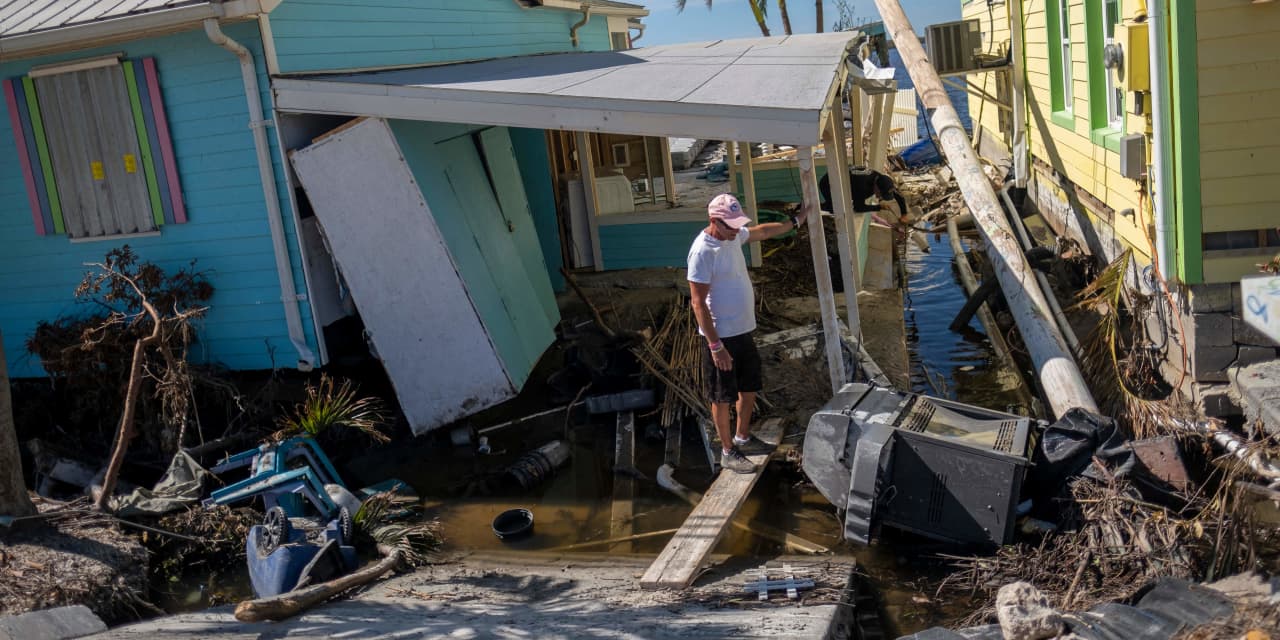
When natural catastrophes hit, insurance payouts don’t always cover the total costs to rebuild. Homeowners could have difficulties making mortgage payments, especially as high insurance costs further strain their bank accounts. In extreme cases, the damaged properties might not recover at all. But such risks aren’t incorporated in mortgage pricing.
“If you are underwriting a 30-year loan on a property at the Outer Banks of North Carolina, which will likely be washed into the ocean in 10 years, it needs to be taken into account very explicitly,” says Eddie Seiler, executive director of the Research Institute for Housing America at Mortgage Bankers Association. “We’re not there yet as an industry.”
Even when insurance covers the physical damages, home values in disaster-prone areas could fall if more people move away, leaving lenders and investors of their loans holding the bag.
Concerned about such risks, the mortgage industry is spending big bucks on climate data and analysis, but it’s a challenging task: There simply isn’t enough certainty about climate change ‘s trajectory and how it would affect individual areas in the long term.
The various climate-risk models often spit out very different projections, says Timothy Judge, head of modeling and chief climate officer of
Fannie Mae.
“We use a lot of external providers because I find it hard to believe that there’s any one model capable of giving property-level analytics that are really accurate.”
Another thorny problem: Areas exposed to higher climate risk are often also places with higher concentrations of black, Hispanic, and lower-income households. If lenders start pricing loans based on climate risk, the financial burden will disproportionately fall on communities that already struggle to buy a home.
“The immediate reaction when you see a risk might be to change the pricing,” says Emily Westendorf, climate risk program manager at Cincinnati-based Fifth Third Bank. “However, that can be quickly detrimental to the end customers.”
Instead of cutting off lending or raising rates, lenders can mitigate climate risk by educating borrowers to make their property more resilient, says Westendorf. Good credit risk management could also help find borrowers with solid financials, who are more likely to withstand the negative events.
A lot of the risks will be taken on by government-sponsored enterprises like Fannie Mae and
Freddie Mac,
which insure more than 60% of outstanding mortgage debt in the U.S. but charge a flat fee for their guarantees no matter where the property is located.
The same concern remains: Historically redlined areas also tend to be at higher climate risk. “We have to be very mindful of the impacts of changes on vulnerable communities,” says Judge from Fannie Mae.
But this means lenders could pass on the climate liabilities to taxpayers without paying extra for the mortgage insurance they get. In a 2020 research article, Jesse Keenan, associate professor of real estate and urban planning at Tulane University, and co-author Jacob Bradt, found that local lenders in the Southeast U.S. have been securitizing more mortgages in high-risk coastal areas and selling them to the federal guarantors.
Even for mortgages protected by federal insurers, investors could be subject to prepayment risk. If a property is destroyed and the homeowner walks away, the mortgage would be bought out and the principal returned early. That means lenders won’t receive the interest payments they expected across the life of the loan.
“If you’re buying a bond with a duration of five years, but it turns out to be a four-year bond because of early buyout, that could obviously change your risk profile and realized return,” says John Bastoni, a senior trader at Breckinridge Capital Advisors.
So far, the housing market hasn’t priced in the climate risks. Drawn by affordable housing and booming local economies, millions of Americans continue to move to areas vulnerable to hurricanes, wildfires, and extreme heat. Many of these places have seen home prices rise higher and faster than the national average.
Local and federal government has spent billions of dollars to rebuild homes and infrastructure after major disasters. New developments are approved to assuage housing shortage—but many are built in some of the least habitable environments like deserts and wetlands.
“States let local governments run wild, and local governments are basically in competition with each other for more development and tax base,” says Tulane’s Keenan. “It’s like eating Halloween candy and getting a sugar rush of cheap housing, but the crash is coming.”
According to a February research article in Nature Climate Change, U.S. homes exposed to flood risk alone could be overvalued by as much as $237 billion. Low-income households, particularly, are at greater risk of losing home equity from price deflation.
“We’re still seeing people live in Phoenix with their crazy heat and water stress, and we’re still seeing people move to Miami even with hurricanes and floods risks.” says Brittany Ryan, head of sustainability at Nuveen. “At some point, the risk is going to be so bad and the market is going to flip, but the question of when is kind of a crystal ball.”
Corrections & amplifications:
Fifth Third Bank is based in Cincinnati. A previous version of this article incorrectly said it is based in California.
Write to Evie Liu at [email protected]
Read the full article here