



President Donald Trump unveiled a sweeping new savings initiative for children, dubbed “Trump accounts,” a government-created investment program established under the One Big Beautiful Bill Act.
The accounts function much like traditional long-term investment vehicles, but with rules specifically designed to protect young savers. Available only to those under 18, they’re funded through federal seed money, private contributions from families and, when applicable, supplemental deposits from employers or nonprofit organizations.
However, the rules for how these accounts will actually operate are still being written, with many key details unsettled.
The IRS has issued only preliminary guidance and is now seeking public feedback, a formal process that allows parents, financial experts, companies and advocacy groups to comment before the regulations are finalized. The comment period remains open through Feb. 20, 2026, meaning many details of the program are still subject to change.
Here’s what is known so far:
Who is eligible?
A Trump account can be opened for any child under 18 years old who has a valid Social Security number. An authorized adult, typically a parent, guardian, adult sibling or grandparent, must be the one to establish the account.
When can I sign up for one?
Not for a while.
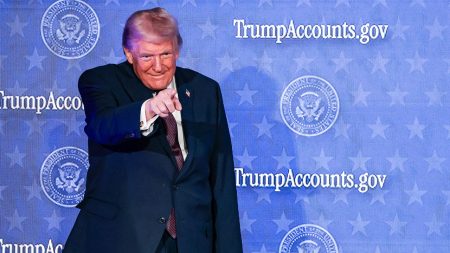
The program is scheduled to become available in mid-2026, with initial contributions occurring after July 4, 2026. Parents of babies born in 2025 through 2028 may open an account by completing IRS Form 4547, which has not yet been issued by the IRS, or by enrolling via the online portal at TrumpAccounts.gov.
MICHAEL AND SUSAN DELL DONATE $6.25B TO FUND ‘TRUMP ACCOUNTS’
After the application is received, the Department of the Treasury will initiate the account activation process.
Who can add funds to the account?
Individuals can contribute up to $5,000 per year to a Trump account. Governments and nonprofits may also make eligible contributions. In addition, funds from another Trump account may be rolled over, meaning money already held in one Trump account can be transferred directly into a new or different Trump account without counting toward the annual contribution limit.
Employers participating in a Trump account program may contribute up to $2,500 per year.
How do I receive the $1,000 deposit?
The $1,000 comes directly from the federal government. The Treasury will make a one-time $1,000 deposit into every eligible child’s Trump account.
How does the account earn money?

A Trump account grows in value because the money inside it must be invested in broad U.S. stock index funds, the same kinds of low-cost funds used in many retirement accounts.
These funds track the overall performance of the U.S. stock market. As the companies in the index grow, the account’s value grows, too.
‘TRUMP ACCOUNTS’ FOR NEWBORNS COULD GROW TO $1.9M, TREASURY SAYS
The government strictly limits what these accounts can hold to keep them simple, low-risk, low-fee and broadly diversified. This means, families cannot pick individual stocks, chase trendy thematic funds or invest in narrow sectors like tech-only or energy-only products.
The IRS wants the money invested in market-wide index funds that mirror the overall U.S. stock market, not any single slice of it.
And because the funds can’t be touched until age 18, the account benefits from years of compounding, where investment gains generate additional gains over time.
Are there any estimates of how much money these accounts could actually earn?

Yes – Treasury estimates indicate that the Trump accounts could accumulate into a seven-figure balance by early adulthood if families maximize contributions and allow the funds to grow.
A fully funded account could reach as much as $1.9 million by age 28, according to the Treasury’s Office of Tax Analysis. At the lower end of projected returns, the savings account could still yield nearly $600,000 over the same period.
Even without additional contributions beyond the federal government’s initial $1,000 deposit, Treasury estimates the account could grow to between $3,000 and $13,800 over 18 years.
When can I withdraw the money?
Trump accounts are designed to function as long-term investment vehicles for children, so the money is effectively locked in until the child becomes an adult. During what the IRS calls the “growth period” (from birth until Jan. 1 of the year the child turns 18), money generally cannot be taken out, even if the family experiences financial hardship.
Are there any exceptions?
Yes. There are four narrowly defined exceptions that permit withdrawals. The IRS intentionally maintains strict limits to keep the funds invested for long-term growth.
What happens when the child becomes an adult?
The beneficiary will be allowed to withdraw funds once they reach age 18. At that point, the account begins to function much like a traditional IRA, with the same tax treatment, distribution options and early-withdrawal rules.
However, it retains a distinct legal identity that never fully goes away. This matters because a Trump account doesn’t simply convert into a standard IRA, it carries forward several structural differences that continue to influence how the money can be used, taxed and reported throughout the beneficiary’s life.
In practice, this means adults who inherit a Trump account will have to manage it alongside any other retirement accounts they hold, with its own reporting rules and contribution limitations.
Read the full article here