



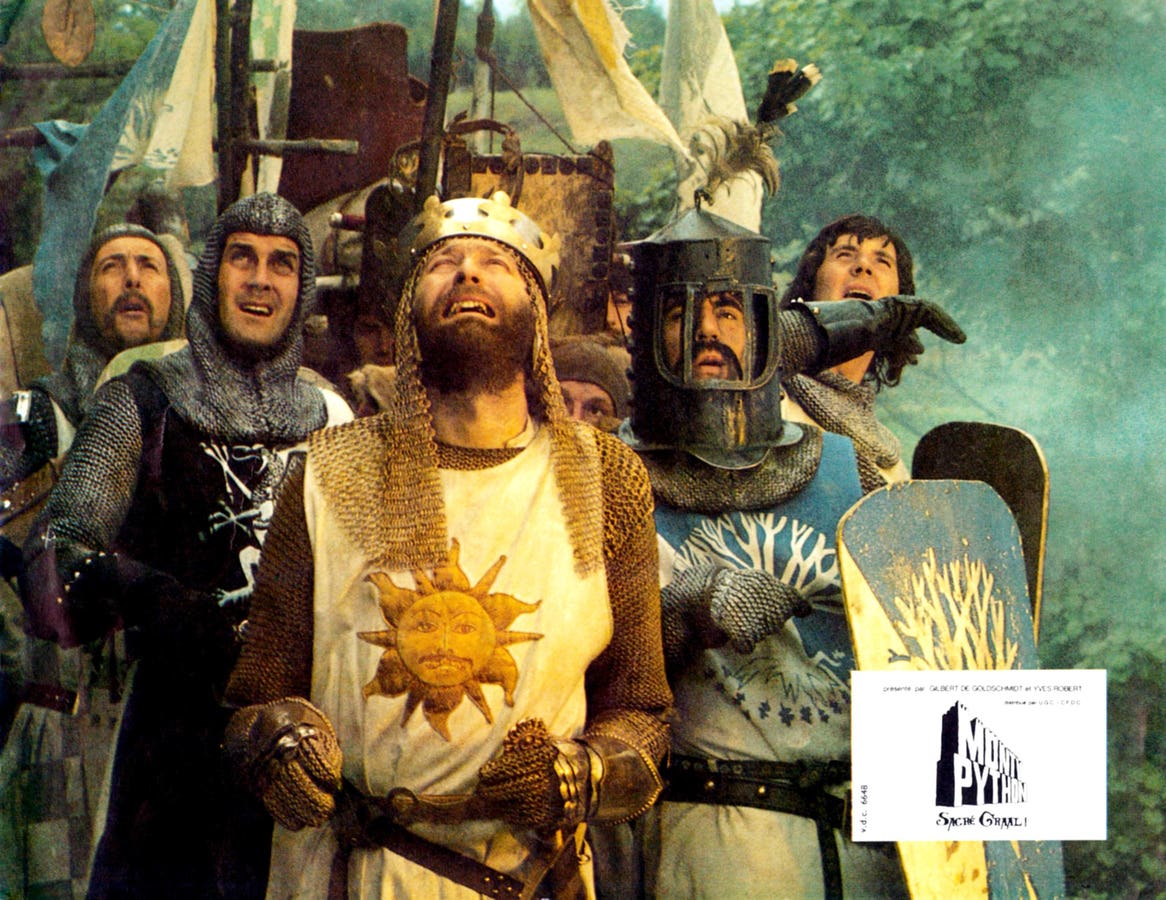
One of the most, uh, formative movies for me as a teen was Monty Python and the Holy Grail. My favorite hysterical characters in the movie were all played by a single actor, John Cleese, who continues to entertain and educate to this day. And at the age of 85, it seems that he’s shifted from delivering a meaningful message surreptitiously through laughing out loud to sharing hard-earned wisdom with merely a hint of comedy.
For example, in a recent Substack post, Cleese raises the question, “Why do we only have one word for ‘know’?” He notes that when he was in French class as a kid, he learned two words for “know,” only to find later that German and Spanish also have two, while we’re left with only one in our native English. And herein lies the problem (and the solution).
The “know” pairings leave space for two levels of learning—intellectual knowledge of the facts, on the one hand, and actually knowing how to do things, through application. I’d like to submit that we can do even better and consider four different phases of knowledge that can well be applied in life and money.
Level 1: Raw knowledge
“Just the facts, ma’am,” Joe Friday might’ve said. And indeed, without them, we have no legitimate starting point. And while it could be argued today that the world awash in sensationalized commentary unmoored from facts, it’s equally true that facts alone may lead us astray.
This first foundational level of knowledge is what we learn in school and books. It’s textbook knowledge with little animation that we can regurgitate, but it’s sorely lacking.
For example, Cleese shares the humorous anecdote about a professor who dedicated himself later in life to learning how to swim. He acquired books on the topic, bought some swimming trunks, and went down to the river. But upon completing the books at river’s edge, he concluded that he’d learned everything he needed to know about swimming and, therefore, didn’t even need to engage in the act itself.
His goal was to know how to swim, and he considered the objective complete. As he stood to return to his office, his friends finally goaded him into the water where he summarily drowned.
Raw knowledge alone often isn’t enough, and it might even be dangerous.
Level 2: Application
At the second level, we apply what we’ve learned. We put it into practice. And we ideally apply our knowledge first in a safer environment. To stick with the swimming metaphor, the Olympic legend and Baltimore native, Michael Phelps, recently responded to a request from a handful of Ravens football players to teach them how swim. And as you might imagine, they started in the low end and used props that helped them float until they got the hang of it.
Undoubtedly, one of my favorite things to do in the professional domain is to help younger, hungry financial advisors cross the bridge from knowledge to application, a daunting task for anyone in any field. But as John Cleese might suggest, until you actually know through doing, you don’t really know.
However, this second stage isn’t where knowledge fully blooms. We still have two more steps.
Level 3: Critical Thinking
If step one is learning the rules and step two is practicing them, step three might just be learning how and when to bend or even break them. It’s learning the smaller subset of exceptions and understanding the context in which they apply.
Critical thinking is about pattern recognition, a willingness to test our own assumptions and question the veracity of the facts at hand. It’s guarding against overconfidence, acknowledging when we may be mistaking correlation for causation, and borrowing from other fields to fill in gaps unclaimed by our areas of specialization.
For example, within the domain of personal finance, you may gain the raw knowledge that you should save 10% of your income each year to help ensure that you can recreate your income when you’re no longer able to work. Then, you may apply that practice by opening a 401(k) and setting aside that number.
Critical thinking, however, recognizes that life isn’t linear. You consider the likelihood of marriage and children, a golden doodle, a house with a mortgage (in an interest rate environment like today!), and saving to send those kiddos to college. Then, you consider the fact that once they graduate, your expenses are going to rapidly decline at a time when your earning potential is peaking.
The critical thinker, therefore, deduces that you may be well served to start saving at a much higher rate earlier in life, recognizing that your ability to save in the middle may be diminished—only to pile on the savings again toward the end of your career.
So, what’s better than that?
Level 4: Wisdom
Wisdom is knowledge informed by application, tested by critical thinking, and infused with purpose.
Wisdom is still.
Wisdom is quiet.
Wisdom is steady.
Wisdom is grounded.
Wisdom is seasoned.
Wisdom is unhurried.
Wisdom is measured and patient.
Wisdom is balanced and centered.
Wisdom is whole, integrated, aligned.
Wisdom is often no when everyone else is yes.
Wisdom listens and asks more than it talks and tells.
Wisdom controls what you can, while being at peace with what you can’t.
From a financial perspective, I believe wisdom is, indeed, planning for the unknown while enjoying the known. It is knowing what money and riches can do well and knowing where they fall short. It’s understanding that wealth isn’t a number but a hard-won feeling. It’s pursuing Plan A, but being content with Plan Z.
It is financial planning in the language of life: growing, protecting, and giving so that you can live in pursuit of your Net Worthwhile.
It is both knowing how to swim, doing so without drowning, and floating through the water with ease.
And it is definitely laughing along the way.
Read the full article here