

Nine days ago, Jamie Dimon, the CEO of the world’s most important bank, JPMorgan Chase (JPM), called this moment “the most dangerous time the world has seen in decades.” As much as I recognize the danger of this time, I was dismissive of this perilous jeremiad. My reasoning? The Republic has already faced a moment in which it was acceptable to think that all banks should be nationalized. In the wake of the Great Recession , we lost 500 banks representing $1 trillion in assets. It seemed logical to many serious commentators that no bank was worth saving. Just federalize them and then start over. Until former Federal Reserve Chair Ben Bernanke said on CBS’ “60 Minutes” in March, 2009, that there would be no more failures, it was acceptable to think it was even Fed policy to let all the banks go down. That was perilous. That was the “most dangerous time.” It was the systemic risk we all dreaded. But we got lucky. Bernanke did save the banking system with those comments. I applauded him and even dedicated a book to him. But what I didn’t do enough is to excoriate him for letting it get to the point that he had to save the banking system. He simply didn’t see it coming, way back in 2007, when I said he and his team knew nothing of what was to come. What is so perilous about this moment, without caving to the attention-getting hyperbole? Firstly, I’ll say that one does not receive medals for dismissing the danger. You only get praise for calling it out. So, things are asymmetric. And Jamie Dimon wins no matter what. You might ask, then, why contradict? I do so strictly out of conscience. If I claim that it is the most fearful time in decades, I denigrate the memory of 2009. I can be taunted as being a “denialist.” But I feel I have to put things in to context. Dimon will not be called out if things resolve themselves. No one ever has to be called out for shouting fire in this crowd. You can shout fire all you want. I, on the other hand, believe that you shouldn’t do so. I have a meager fire extinguisher. This is not 2009. It is not systemic. It is, however, by all appearances not a great time to be long stocks. That’s not unusual, though. According to the endless number of so-called wolf callers, including every single billionaire I have seen on air, it is never worth it to be long. It is only in hindsight that they were wrong. Hindsight has no memory, or accountability. But what happens if hindsight ultimately shows it is not the worst time in decades? You will have missed a decent time to buy and the billionaires will simply be long general-obligation municipal bonds — and their private planes won’t be repossessed. A good time was had by all billionaires. What are they so worried about? First and foremost, some sort of nuclear confrontation with Iran, along with rising U.S. tensions with Russia and China. There is the horror of a potential Israeli ground invasion of Gaza and the concomitant anti-Israel outpouring. The sudden re-focus from the tragedy of Hamas’ attack on Israel two weeks ago, to what’s now been labeled the global humanitarian crisis perpetrated by Israel in Gaza, feeds the sense of peril. More broadly, the possibility of Iran becoming overtly involved as a defender of terrorism — terrorism that it has funded for generations, including through support of Hamas — could entrap the U.S., which, reluctantly, might be forced to take action. That’s peril number one. It would be short-term perilous but, I think, less perilous in the long term. The weakest member of the axis of evil would be terminated. But before that could happen, the markets would fall in response to Iran’s actions and the U.S. commitment to defend Israel. Second, there is a belief that the U.S. cannot fight in the Middle East, Ukraine and the Taiwan Strait all at once. This is a media fiction. A proxy army is fighting Russia. A proxy army is fighting Hamas and Iran. And there is no war in Taiwan — although there is the possibility of China taking advantage of the chaos, with serious knock-on effects for the global semiconductor industry following the U.S. crackdown on chip exports to Chinese customers. All three enemies — Iran, Russia and China — are, indeed, being challenged by the U.S. in some capacity. But the billionaire bear class doesn’t seem to believe in the ability of the U.S. to do anything right. It hasn’t believed, sadly, since World Ware II in our nation’s power. That, to me, is the subtle undertone of this rearguard bearish parry. Jingoism? No, just another way to parse the words I hear. Third, there is the debt, which is bad for both stocks and bonds. I have no idea how to get the debt under control. I do believe it will move the yield on the 30-year Treasury beyond the yield of the 1-month Treasury , at a minimum 6% on the long end versus 5.75% on the short. That’s unless the Fed takes the fed funds rate to 6%, which would probably result in bringing the long rate to 7%. And at 7%, you do some serious damage to the U.S. consumer, who is already struggling with student debt and interest on car payments. Right now, though, it is obvious that as long as employment stays as robust as it is, the consumer will remain surprisingly strong. Rates are going to get too high for the pundits to handle, even as I think the market will take it more or less in stride. High rates are going to cause a further shrinkage of the multiple for the S & P 500 , as more recession fears get built in. But is it really too much to argue that multiple compression is not on par with “the most dangerous” of times? I don’t think so. It is undeniable that the debt is too high. The markets are paying the ongoing consequences. Hence, the endless price target reductions on stocks that we must endure. They are at the heart of the grind of the bear market within a longer-term bull market. Fourth, the lack of faith in both Fed Chair Jerome Powell and Treasury Secretary Janet Yellen to respond to any and all challenges infuses a lot of peril. These two will never get respect. I regard Powell as incredible. He makes mistakes and he course corrects, but the mistakes are all we seem to remember. Again, these criticisms are all sotto voce — and undeserving — but part of the endless tinder to the “ineluctable” fire of inflation, followed by deflation and recession. We’ve heard the sirens on this one ever since the inverted yield curve foretold the economy’s supposed demise. A lot of good that did. Fifth, the subtext of our economic decline as a nation is always lurking in the background. But I look at the U.S. dollar and its endless strength versus every nation, including the currencies of Russia and China, as the relevant barometer. This peril, therefore, doesn’t hold up under close scrutiny. The lack of foreign interest in our paper is disturbing, but no more disturbing than our profligate federal budget and the actual interest it generates. Make no mistake about it, though, when it comes to the Dimons of the world, this decline is second only to the prospect of thermonuclear war. To take these five fears together is to generate a slate of potential harm that could, of course, cause the S & P to decline back to levels we haven’t seen since the Covid-19 pandemic. I do not deny that. I just deny the possibility of the bears going five-for-five as if, somehow, they play for the economic analogue to the dynastic Houston Astros. Me? I am not arguing garden-variety peril. I am auguring some potential headwinds, if not gale-force wins. But I am, reluctantly, not in the camp that says its 2007-2009. Why? Simply because, intellectually, I think it’s wrong. I envy those in that camp, even as I must call them out here, with the expectation that they can only make themselves right for so long before needing to buy stocks in earnest. (See here for a full list of the stocks in Jim Cramer’s Charitable Trust.) As a subscriber to the CNBC Investing Club with Jim Cramer, you will receive a trade alert before Jim makes a trade. Jim waits 45 minutes after sending a trade alert before buying or selling a stock in his charitable trust’s portfolio. If Jim has talked about a stock on CNBC TV, he waits 72 hours after issuing the trade alert before executing the trade. THE ABOVE INVESTING CLUB INFORMATION IS SUBJECT TO OUR TERMS AND CONDITIONS AND PRIVACY POLICY , TOGETHER WITH OUR DISCLAIMER . NO FIDUCIARY OBLIGATION OR DUTY EXISTS, OR IS CREATED, BY VIRTUE OF YOUR RECEIPT OF ANY INFORMATION PROVIDED IN CONNECTION WITH THE INVESTING CLUB. NO SPECIFIC OUTCOME OR PROFIT IS GUARANTEED.
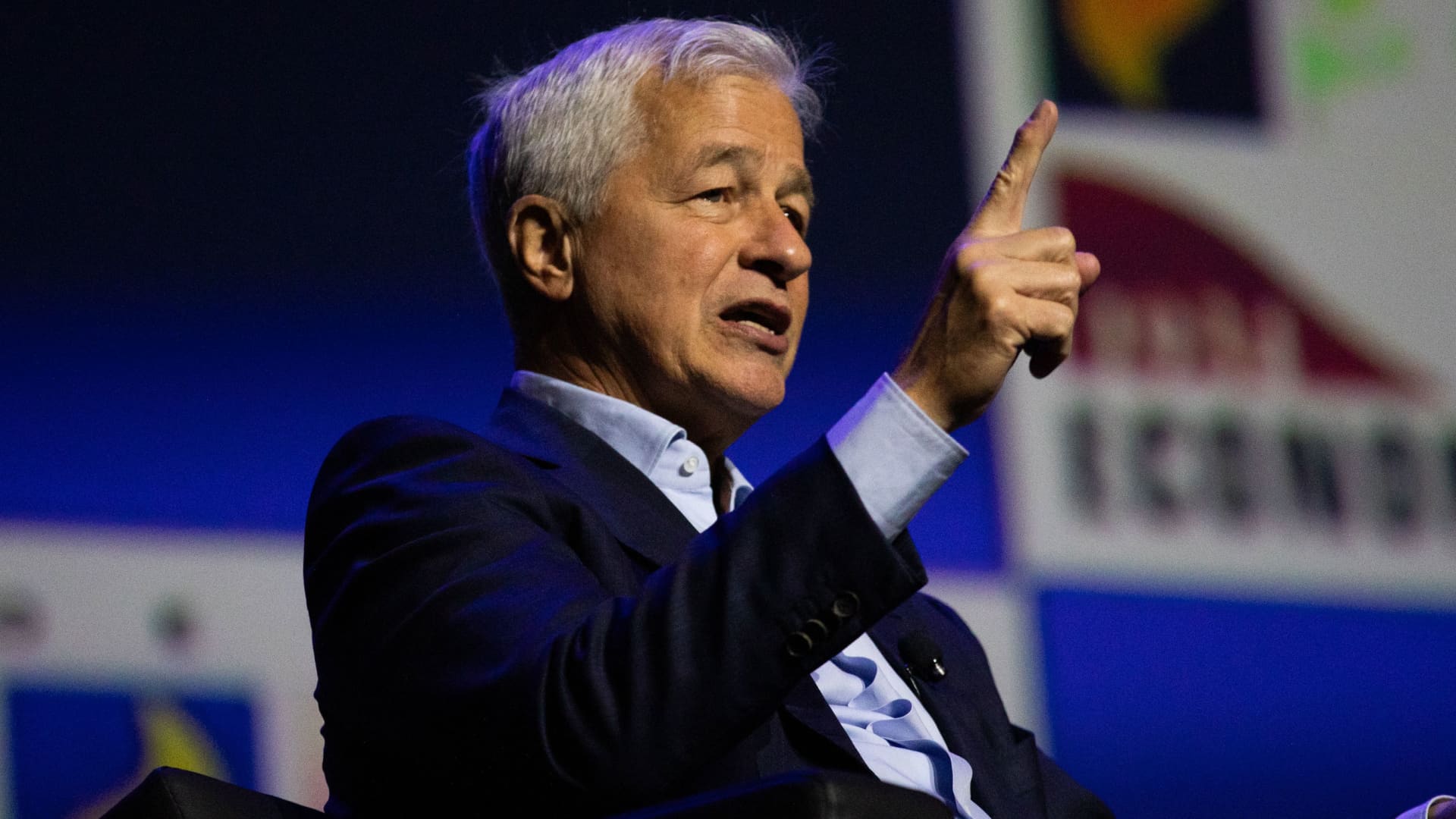
Nine days ago, Jamie Dimon, the CEO of the world’s most important bank, JPMorgan Chase (JPM), called this moment “the most dangerous time the world has seen in decades.” As much as I recognize the danger of this time, I was dismissive of this perilous jeremiad.
Read the full article here