



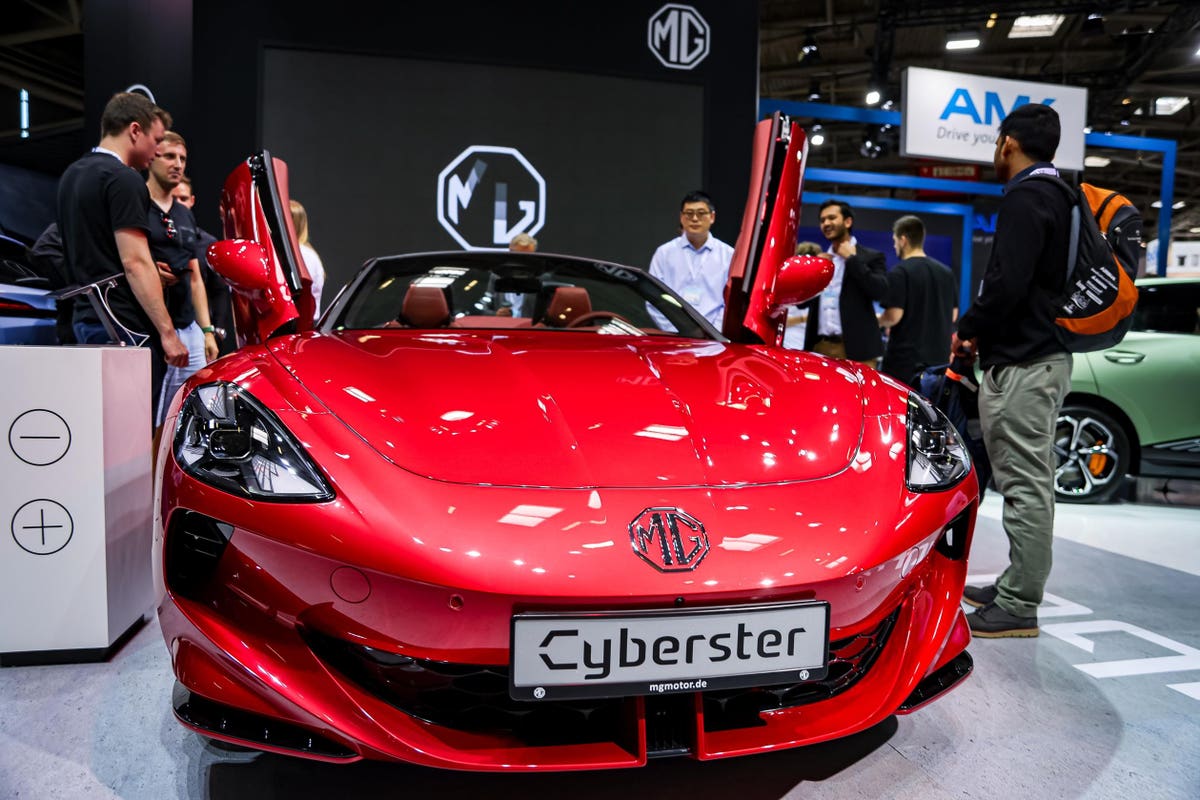
Europe’s manufacturers are braced for a Chinese electric car sales onslaught but the impact will be mitigated by their establishment of European factories and willingness to set up local joint ventures.
Threats of tariffs won’t stall China’s threat to European electric carmakers, but the plans might stumble as the promised exponential gains in electric car sales meet the consumer reality of high prices, inadequate performance, patchy power availability and a skimpy charging infrastructure.
If those problems aren’t solved, electric car sales may plateau prematurely, scuppering assumptions and causing consternation in the industry. Hostilities between Taiwan and China would be an all-bets-are-off nightmare.
European manufacturers await a sales onslaught from an assortment of Chinese companies. But auto industry consultants JATO Dynamics, in a report, expected success for the Chinese, but said this would be more orderly than words like “invasion” would suggest. The process would include establishing factories in Europe and joint ventures with local companies.
According to investment bank UBS, Chinese giant BYD has a 30% cost advantage over Western incumbents, offering competitive prices in Europe, even with tariffs, shipping costs and more costly local production. The implication is that all Chinese automakers have similar advantages.
Bernstein Research thinks this is an underestimate.
“China can produce EVs which are 50% cheaper than the West, given scale and labor costs advantages. Europe cannot match this and could become increasingly protectionist towards its auto industry. Regardless, China EV makers will take a higher share of the global EV market,” Bernstein Research said in a report.
Investment bank Morgan Stanley said any action taken by the European Union, which has started an anti-subsidy inquiry into the China threat, won’t make much difference.
“We believe any trade restrictions would slow, but unlikely derail, China’s EV launch, given their competitive product offerings and well-established supply chain,” Morgan Stanley said.
Schmidt Automotive Research says its forecast earlier this year that by 2030, Chinese BEV sales in Western Europe (includes all the big markets Germany, France, Britain, Italy, Spain) will hit 1.2 million or 9% of the BEV market is now slightly conservative. Investment researcher Jefferies forecast that in all of Europe, BEV sales will hit 9.3 million in 2030, up from just over 1 million in 2021 and 4.8 million in 2025.
This is a truly massive automotive revolution, with volume increasing by almost 10 times in 9 years, and although it seems to be accepted by a great majority of politicians, economists, forecasters and the industry itself, it requires many controversial factors to fall into place.
Firstly, electric cars need to be affordable. Sales were launched in Europe by well-heeled early adopters, followed by corporate purchasing of company cars. But if all sections of the market are to be included, prices must fall dramatically. The average price of an all-electric car is now close to €30,000 ($31,800) after tax. This needs to be at least halved if consumers on average earnings are included. Some experts say battery prices are going to fall, but this now seems to have gone into reverse.
Given the current shortages of crucial and scarce battery components like lithium, nickel, cobalt, manganese and graphite, and the fact demand is going to increase by more than 4 times between now and 2030, it’s hard to see how battery prices can do anything but rise sharply.
Battery-powered cars are terrific on city streets and country roads, but hopeless if you need to drive long distances on high-speed highways. That shows no signs of being solved, even for the battery technology leaders of China. The massive increase in demand in Europe by 2030 requires a similar increase in electric power delivery. That’s a cause for concern, as is the need for a ubiquitous charging network.
Donald Sadoway, Professor of Materials Chemistry at the Massachusetts Institute of Technology (MIT), said demand by consumers for electric cars globally is likely to plateau because the inherent disadvantages of electric cars compared with internal combustion engine (ICE) powered ones look set to last. Unless battery-power can make big improvements, the lack of range and a reliable infrastructure will weigh on sales. This could be a nightmare for the industry.
“I believe the race towards electric personal vehicles will hit a plateau because of these uncertainties. As ICE cars are phased out, but the demand for electric vehicles disappoints and we end up with an over-supply, now what,” Sadoway said in an interview. He didn’t say when the plateau might be reached.
JATO Dynamics, in a report called ”Perception: The last barrier for Chinese cars”, said demand in the China home market is flagging, and overseas markets, particularly rich ones like Europe, appear like low-hanging fruit to the likes of BYD, SAIC’s MG, Geely and its Polestar and Lynk & Co subsidiaries, Chery, Great Wall and Dongfeng, among others. Chinese quality is more than adequate to win sales in the lower and middle sectors, but the likes of BMW, Mercedes, Audi and Porsche can remain smug for a while yet.
And the invasion has only just begun. In 2022, Chinese car brands had 1.57% of the European market. According to JATO Dynamics, this crept up to 2.37% in the first half of 2023.
Felipe Munoz, Global Analyst at JATO Dynamics, said in the report joint ventures would extend past manufacturing of vehicles and the impact would be gradual.
“In the coming years we expect to see further collaboration between Western legacy carmakers and Chinese (manufacturers) through joint ventures in areas like technology and charging infrastructure. We may also see more Chinese (manufacturers) following the example set by SAIC in acquiring Western carmakers.”
SAIC acquired the legendary British brand MG in 2007.
Munoz said in an interview by 2030 Chinese manufacturers, including MG, could get around 6 to 8% of all European new car sales. That compares with Japan’s current 13% share and Koreans almost 9%.
“China might have more resources, but it faces more reluctance from consumers than the Japanese and Koreans had some decades ago. In addition to this, my basic forecast is based on the assumption that there won’t be any direct confrontation between China and Europe/USA. This can also change everything,” Munoz said.
“I would not talk about an invasion, as the current data shows Chinese car brands, MG included, Polestar/Volvo excluded, made up just 2.3% of (sales) through August, and 60% of the volume corresponded to MG, not positioned/recognized as a Chinese brand by the consumers. There are definitely interesting cars that would change the game, MGs, some BYDs, Geelys, Cherys, but they first need to address the negative perception strongly related to the pandemic, years of copycats from the Chinese industry to Western cars, low quality issues in the past, and the rising economic/political tensions with China,” Munoz said.
What about the notion of a sales “plateau” soon?
“I think this is already happening, not only with BEVs but with all cars. The semiconductor shortage is an example. In the end the industry adapted and made even more money. That could eventually happen with the BEVs and its raw materials and the energy required for the grids,” Munoz said.
Matt Schmidt of Schmidt Automotive Research said he expects Chinese sales to accelerate, once factories are established in Europe.
“MG and BYD are already looking and we expect an announcement by the end of this year,” Schmidt said.
Short-term sales growth is expected to take a dive this year though, before resuming when EU regulations hitting ICE sales take effect after 2025.
“Growth will likely slow dramatically in the final third of this year. The market has been skewed during the opening two-thirds of the year due to thick order books from a pull-forward effect at the end of last year to avoid increased taxes in Norway, grab the last purchase subsides in Sweden and the U.K., a pull-forward from German corporate customers that saw subsidies wiped out at the end of last month and which caused the German market to account for over 40% of the total region’s BEV volumes in August. The final third of the year looks bad,” Schmidt.
The elephant in the room is of course the nagging possibility that all these expensive plans might count for nothing if China invades Taiwan.
“The geopolitical headwinds are certainly worrying, not just for Chinese companies hoping to do business outside their borders but also to Europeans such as German (manufacturers) highly exposed to China,” Schmidt said.
Munoz agrees.
“I think the industry is in general getting ready for this scenario. They are starting to cut dependence on Chinese suppliers. However, a real war changes everything.”
Read the full article here