



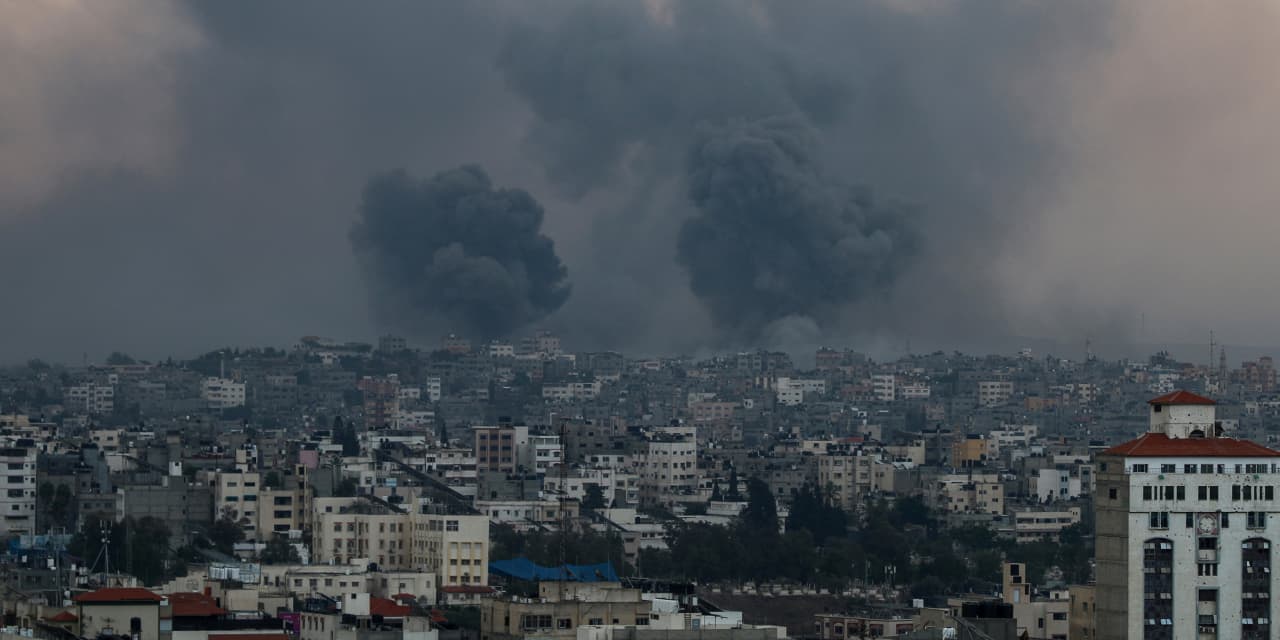
Smoke rises after an Israeli bombardment on Oct. 9 in Gaza City.
Ahmad Hasaballah/Getty Images
Market reaction to the terrifying violence in Israel suggests that investors view it as an important event but not necessarily as a geopolitical turning point. Oil prices are up, but still below last week’s peak. Treasuries are showing a modest flight to safety. Stocks wobbled and then turned up.
On the whole, that is a rational reaction. It is premised on the idea that events will play out in a certain range, in which the violence stays relatively contained to Israel and Gaza. “At the beginning of every one of these major cycles of violence it seems like it’s different this time, and that’s what I would remind investors,” said Marko Papic, chief strategist at Clocktower Group. The Israel-Palestine conflict hasn’t been market-relevant in the past, and this time isn’t really likely to be different, he said.
The issue that is worth chewing on—as Papic also does in his analysis—is whether the background conditions keeping the global economy relatively orderly will hold. And that can be boiled down to roughly three unknowns: One, what does Iran want to happen next? Two, will the U.S. role in the conflict dampen risks or escalate them? Three, what does the rest of the world do?
Start with Iran, and leave aside for now the question of whether it was involved in the planning of Hamas’s operation, because that speaks more to what the U.S. and Israel will do next. More important is to acknowledge that Iran has agency in this situation, and it can choose to escalate the situation, or not.
Iran is a diplomatic outcast and remains under draconian sanctions. It has one main tool to effect change right now, and that is by using hard power to force its adversaries to the bargaining table. Iran can make itself a problem the rest of the world needs to solve, as Johns Hopkins University’s Vali Nasr put it earlier this year. “If we escalate, more than likely they will need to make this problem go away,” he said, describing how Iran thinks.
A 2019 attack on Saudi oil facilities took roughly 5% of global oil production offline in an assault the U.S. blamed publicly on Iran. That episode was the backdrop to Iran and Saudi Arabia’s surprise decision earlier this year to begin to normalize relations. Iran can do so much damage to its adversaries that they just have to deal with it—or at least it can try.
That is why analysts are closely watching for reactions from Hezbollah, Iran’s proxy in Lebanon. It didn’t join the initial attack on Israel. A choice to get involved now by attacking Israel would likely show intent to escalate, and the path from there would be difficult to predict.
The second unknown relates to Washington. The U.S. response so far has been to full-throatedly back Israel and effectively stand back and let the military campaign play out. A U.S. aircraft carrier is on its way to the region, the U.S. secretary of defense said. One of its goals is “to bolster regional deterrence efforts,” a thinly veiled reference to Iran.
The Wall Street Journal reported that Iranian officials helped plan the attack. U.S. Secretary of State Antony Blinken said Sunday he had not seen evidence Iran directed it. That posture from the U.S. makes sense, said Gregory Brew, an Iran analyst at the consulting firm Eurasia Group: “The U.S. strategically wants to contain the crisis. They want to avoid having it escalate beyond Gaza.”
Whether the U.S. and Israel go further in directly addressing Iran “is a key source of escalatory risk,” said Brew. Iran has been exporting more oil lately, despite sanctions, and much of that oil is headed to Chinese refineries. Making a move on Iranian oil exports would effectively implicate China when the U.S. has been attempting to reduce tensions. “Provoking the Iranians, provoking the Chinese, and putting upward pressure on oil are all things Biden doesn’t want to do,” said Brew.
Global energy markets held up reasonably well even after Russia’s invasion of Ukraine. That episode produced a rapid reordering of energy flows, but the price shocks were relatively mild. That could be different were the war in Israel to go beyond its borders, and would turn on whether U.S. producers massively ramp up and whether Saudi Arabia brings some of its spare capacity online. Again, the basic question is whether the geopolitics continue in their familiar direction, or whether they go haywire.
The last issue relates to the wider state of the world. Could Russia make matters worse? Iran has courted Moscow lately by sending drones to be used in the war in Ukraine. The point was to buy it some protection for a moment like this. Russia’s war effort has taken a toll on its ability to affect global events, but it is always unwise to count it out entirely.
Likewise, the regional trend in the Middle East has been toward reconciliation with Israel. The Trump administration negotiated the Abraham Accords, helping to establish diplomatic relations between Israel and four formerly hostile states. Israel’s military campaign in Gaza and the response of Saudi Arabia and the Gulf states will test the depth of that normalization. That said, it would take significant public anger in the region to upset the new political balance. “I’m not buying or selling equities in the Middle East based on their governments’ relationship with Israel,” said Papic.
Right now, investors are effectively betting that this moment is the high-water mark for the brand of chaos wielded by Hamas and Iran, that they can unleash hell, but only for so long. The coming days will show how true that is.
Write to Matt Peterson at [email protected]
Read the full article here