



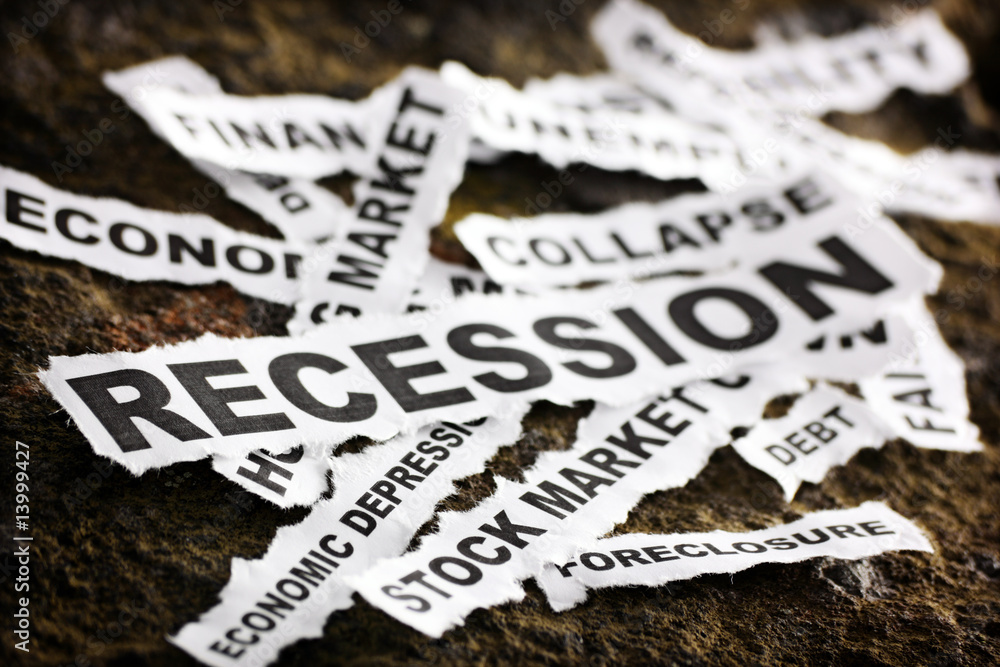
The world of finance and investments is notorious for its extensive use of jargon. With a goal to enhance financial literacy and make the world of money more transparent, we have our “monthly jargon” articles that focus on debunking financial terms that are often used sans explanation. This month, we address a term that has been frequently tossed around in the news these days, leaving many of us wondering what’s to come: “recession.” The term “recession” is not a positive one that you want associated with a nation’s economy, and many of us shun at the mere mention of the term, especially during the challenging epoch we are currently enduring. Put simply, a recession refers to a substantial decline in overall economic activity, and it is generally recognized as two successive quarters of economic decline reflected by gross domestic product (GDP) – the total market value of all goods and services produced within a country for a specific period of time – and additional monthly indicators like a rise in unemployment. GDP is often used as a strong indicator for a recession because it is a broad measure of overall domestic production, and therefore serves as a complete and an extensive account of a country’s economic health. However, the National Bureau of Economic Research (NBER) – a private, non-profit, non-partisan research organization dedicated to conducting economic research and sharing those findings with public policymakers, business professionals, and the academia community – says that the age-old definition of a recession as two consecutive quarters of decline in real GDP is not how it defines a recession anymore. The entity takes the definition of a recession further to account for additional economic factors and defines a recession as a noteworthy decline in economic activity across the economy as a whole that lasts more than a few months.
Pronouncing a recession is not something taken lightly, so how is a recession confirmed and declared? The NBER holds the responsibility of determining when a recession begins and when it ends. The NBER identifies a recession through declines in industrial production, employment, wholesale-retail sales, and real income or real wage, which refers to household income after inflation. The NBER believes this more frequently reported monthly data provides more accurate and timely insights as to the health of the economy, which is why it does not view quarterly GDP reports adequate enough to make the decision of declaring a recession. In terms of defining the length of a recession, the NBER states a recession spans from when an economy reaches a peak of activity and subsequently begins to falter and ends when the economy hits its trough or lowest point of activity.
When we take a look at economic history since the Industrial Revolution that occurred during the late 18th and early 19th centuries, the long-term macroeconomic trends – meaning economy-wide indicators like inflation, rate of economic growth, national income, GDP, and employment – in most countries around the world have involved economic growth. However, as we have seen in the financial markets, growth is not continuously linear – there are ebbs and flows, inclines and declines that are normal, innate behaviors that are to be expected, and the same goes for economic growth. Along this trajectory of economic growth for the past several hundred years, there have been short-term fluctuations of declining performance that typically span from six months up to several years before reassuming the long-term growth trend. These short-term declines are the recessions, and these periods, although unpleasant, are normal parts of an economic cycle, the latter referring to the recurring downward and upward movements of GDP within the long-term growth trend.
So, what causes a recession or temporary shift from the long-term growth trend? There are numerous economic theories that attempt to predict why an economy might fall into a temporary period of decreased economic activity – in other words, a recession – and what the triggering factors could be. These theories involve financial, economic, and even psychological factors, and some economists believe structural shifts in industries like new technologies rendering human labor obsolete or a spike in oil prices due to a geopolitical crisis best explain the beginnings and triggers of a recession.
Special COVID-19 Addition
To put this definition of a recession into context, the COVID-19 pandemic and the succeeding lockdown of the U.S. and global economies is an example of an economic jolt that could provoke a recession. The main difference in our current economic environment is that fundamentals – employment, economic stability, and growth – were strong when the novel coronavirus epidemic hit; there were no indicating factors that a recession was impending, which is most likely one of the main reasons why the NBER has yet to declare this current period as a recession. We are undoubtedly experiencing an unprecedented health crisis that has sent economic fundamentals into recession-like territory; however, if the virus can be contained in a timely manner, and fundamentals like employment, wholesale-retail sales, and real wage rebound quickly, we’ll see that what we have been experiencing is not a recession but rather a health crisis that forced a self-imposed halt on the economy to contain the pandemic. In the meantime, we will leave that decision to the NBER and play the waiting game to see if science can contain the virus before this dramatic economic slowdown caused by the novel coronavirus potentially enters the U.S. into a recession this year.
Read the full article here