

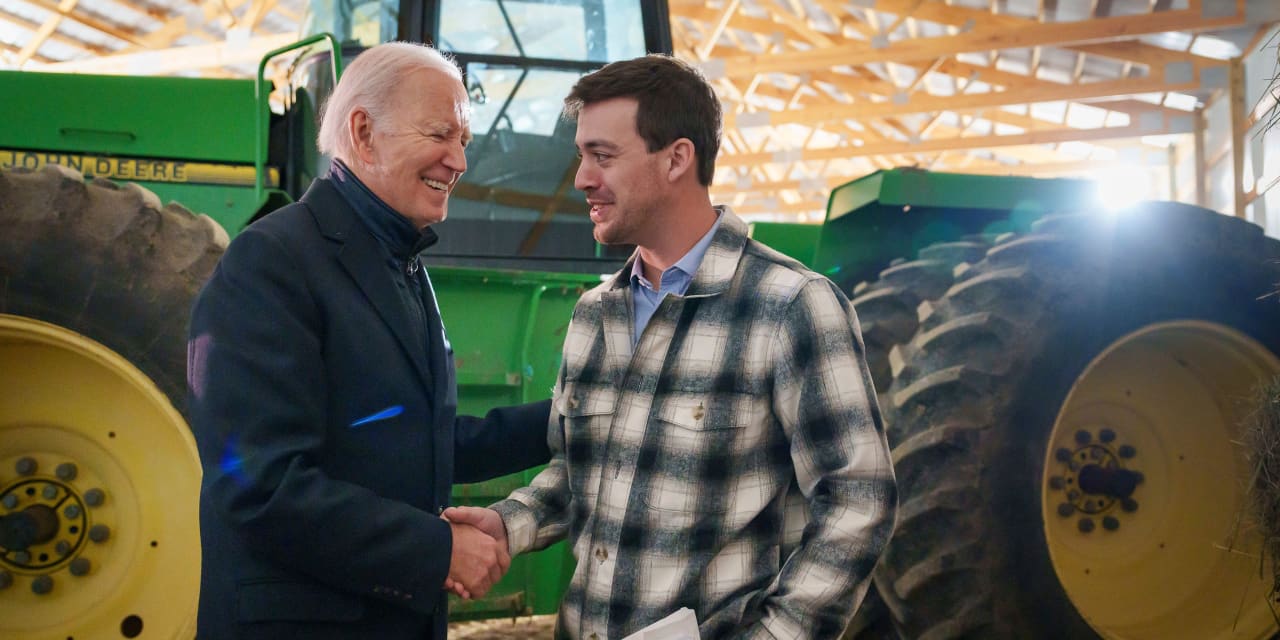
It’s no wonder why President Biden recently embarked on a two week trip criss-crossing the countryside on a “Rural America Tour.” The Inflation Reduction Act is key to his re-election strategy, but over 70% percent of Americans said in a recent Washington Post-University of Maryland poll they have heard little or nothing about it.
Reinvesting in rural America is key to that campaign message. While billions in project funding are still to be announced, we’ve crunched the numbers on the IRA’s effects on rural communities nationwide.
The data are clear: The White House is putting a disproportionate share of IRA funds into rural communities. But while a core promise of “Bidenomics” has been to support communities nationwide, no matter how they voted in 2020, there are signs that the president will struggle to convince rural voters that these investments really are for them.
Rural voters are often dismissed for not getting “the facts” right and mocked for not celebrating the fact that when it comes to solving rural problems, Democrats apparently “work harder at it than Republicans do.” But a little over a year after the IRA was signed into law, the data suggest why rural voters don’t always make these connections.
In August, the national, nonpartisan organization, E2, released a report cataloging the 210 projects announced since the Inflation Reduction Act’s signing. Political insiders noticed the predicted disparities as a majority of projects are flowing to “red” states and Republican congressional districts, despite the GOP’s opposition to Biden’s signature plan.
But despite the conventional wisdom, “red” does not mean rural, and most Republican voters live outside of rural areas. How do these projects stack up in communities that are actually rural?
We dug into the press releases for each announced project and identified the county that would receive the bulk of the new investment, such as for a new factory, a solar generation field, or a battery storage facility. We then used the 2020 Census’ rural population data to determine which of these counties were truly “rural”—counties where 50% or more of residents live in rural areas (somewhat rural) or where 75% or more live in rural areas (very rural). We compared those communities with “very urbanized” counties—places where 90% or more of the population lives in densely populated areas.
Note that these calculations do not rely on government reports or figures. The government has provided little information on where federal monies are going. That’s a problem—both politically, and in terms of good governance. If the goal is to make historic investments in rural areas, then the federal government needs to create systems accessible to the public to hold recipient companies accountable.
Combined, rural counties will receive $38.4 billion, or roughly 28% of the $135 billion that we could geographically attribute throughout the country. About 14% of the U.S. population lives in these communities, so while they aren’t receiving a majority of the funding, the investment far eclipses their share of the population. In other words, if spending were proportional to where people actually live, rural communities would receive about half of what has been doled out so far.
One reason rural areas have stood to gain is simply because of rural America’s geographic size. Urban America simply doesn’t have enough room to accommodate new manufacturing facilities on this scale. Real estate in urban and suburban America is already at record highs. Rural America, on the other hand, has both the space and a comparatively cheaper labor force. What is left of America’s manufacturing core is already in rural areas, and battery plants and other electric-vehicle technologies are incentivized to build near these hubs—especially motor vehicle plants that dot the countryside.
Targeted investments like these will make an economic difference. But politics is all about perceptions. Will rural voters even recognize that billions are flowing into the countryside? Drawing on these data, and what we know about rural voters’ motivations, we have some doubts.
For one, not every dollar announced for a “rural” project will stay in a rural area. When Tesla receives a $3.6 billion grant to build a factory in rural Nevada, inevitably some of those funds go to executive salaries in downtown Houston.
Second, even if a new factory is built in a rural community, that alone doesn’t mean the community will come out on top. The arrival of new industry is exciting, but seldom are rural governments in a position to plan for the inevitable stress major new private investments place on public infrastructure. Confronting decades of manufacturing losses, there is no guarantee, either, that the workers remaining in rural communities will be the ones trained and hired by these companies.
Rural residents are especially attuned to the history of federal interventions that squeeze out local control and exacerbate economic inequality: The wonk’s favorite rural policy—farm subsidies—are overwhelmingly paid out to a relatively small number of massive farms, and have reduced competition in the agricultural sector. Federal incentives for clean energy projects have frequently resulted in lower tax revenues for local communities. Even the president’s broadband investments, for instance, have in some cases squeezed out local efforts to expand internet access.
Given that history, rural residents’ actual lived experience with these new investments will matter the most. Rural residents, more than urban and suburban residents, are much more likely to tie their personal well-being to that of their local and specific community. So it is important to note that, even if a disproportionate amount of money is going to rural areas, just a sliver of the people who live there will directly benefit from the investment. Nearly two-thirds—64%—of the residents of urban America live in a county that has so far announced an IRA project, but just 15% of rural residents live in a county where an IRA project has been announced.
Overcoming that simple fact of human geography will require better messaging, and there’s no denying that the Democratic Party is very unpopular in rural America. Biden and his advisors have wrapped his rural initiative into the larger “Bidenomics” message. But “Biden” is a red-flag warning for rural voters—not to be trusted. And “Bidenomics” will suffer a predictable fate if painted on the sides of every new factory.
Persuasion in politics is an art, not a slogan or a list of facts. The money is coming, but there remains much work to do to ensure that these investments translate into improved livelihoods for rural Americans that we can understand.
Guest commentaries like this one are written by authors outside the Barron’s and MarketWatch newsroom. They reflect the perspective and opinions of the authors. Submit commentary proposals and other feedback to [email protected].
Read the full article here