

Germany’s economy, historically the powerhouse of Europe, is going through a rough patch. Its reliance on Russian energy and trade with China will have to be scaled back and new sources of growth found. Investment will be needed and it will take time. As a result, the country’s stock market has markedly trailed the U.S.’s, climbing 8.7% against the
S&P 500
‘s 14%.
Germany’s gross domestic product declined in the third quarter, bringing down the rest of the euro zone with it. The Organisation for Economic Growth and Development expects Germany to be the second worst performer in its group of 30 advanced economies this year, ahead only of Argentina. It will be among the worst next year, too.
German companies will probably struggle through the tough economic period ahead. But it would seem like a bad bet to count Germany out for the long term. Given the country’s propensity to bounce back in the past, there are at least six contrarian investments that could be winners. But first, it is important to understand the problems the country faces.
The diagnosis of Germany’s biggest issues is easy enough. Consider its recent history of relying on Russia for energy and China for trade.
“The energy transition, along with the lack of another strong export market which is able to absorb all Germany’s products, has put its entire business model at risk,” said Carsten Brezski, an economist at ING in Frankfurt.
Hitching the wagon to Russia and China looks like poor policy choices in retrospect. Russia’s invasion of Ukraine has made energy, and natural gas in particular, substantially more expensive in Germany, putting the country at a competitive disadvantage compared with those who have cheaper sources of fuel. Because gas markets are regional, prices in the U.S. are roughly a fifth of those in Europe.
China, which has helped fuel German manufacturing both by providing cheap parts and a market for German engineering, is facing a difficult recovery. Its years of rapid growth may be coming to an end as it slowly emerges from long Covid lockdowns. The World Bank sees Chinese growth cooling to the weakest pace since the 1960s next year.
Other problems are more homemade. The decision to phase out nuclear power after the Fukushima disaster in Japan in 2011 exacerbated the country’s reliance on Russian fuel and the dirty-burning coal that could be found closer to home. Poor investment in digital technology, transportation and infrastructure in the wake of the financial crisis has hurt productivity as the country deals with an aging population—some economists say the workforce may already be shrinking.
Given these challenges, one strategy for investors would be to look for companies that have been bearing the brunt of them, in the hope that they will pull out of the slump stronger.
Hapag-Lloyd is a global leader in container shipping.
Courtesy of Hapag-Lloyd
Hapag-Lloyd
(ticker: HLAG.Germany), the marine shipping company, could be one. The Hamburg-based firm’s shares have plunged more than 30% over the past three months as freight rates fell. Its American depositary receipts have declined from a peak above $230 in May 2022 to below $70. It trades at 21 times forward earnings, putting it in line with industry peers. But shipping stocks tend to be highly cyclical—Hapag Lloyd could climb quickly as soon as global trade recovers.
For now, the stock is so beaten down, battered in part by China’s weak recovery, that the dividend yield has climbed to 52%. Of course, the projected dividend payouts could change.
On Nov. 9, the company lowered its earning guidance and said it’s cutting some shipping routes to save money. None of the nine analysts covering the company surveyed by FactSet give it a Buy rating—three say Hold and the rest Sell. If you’re looking for a contrarian bet, this one stands out. It’s probably worth bearing in mind that rival Maersk on Friday cut a tenth of its workforce and warned the whole industry is coping with subdued demand.
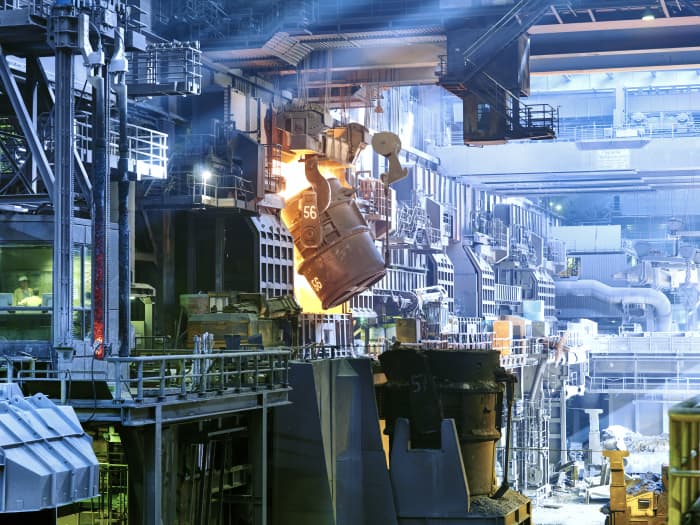
Pig iron blast furnace at ThyssenKrupp’s oxygen steel plant in Duisburg, Germany.
Courtesy of ThyssenKrupp
Another one might be steel maker
Thyssenkrupp
(TKA.Germany). It’s down 4% over the past three months, trading at $7.22 compared with more than $14 in March 2021. To be fair, it’s trading more than 50% higher than it was 12 months ago, but that also highlights its volatility. The company trades at 16 times forward earnings, putting it at a 10% discount to peers.
Making steel and construction materials is resource intensive, and energy resources are much more expensive than they used to be. What’s more, demand closely tracks the health of the broader economy, which hasn’t been great. It’s another stock that doesn’t have a single Buy rating in FactSet. But
Thyssenkrupp
is still a pillar of Germany’s industrial identity—the firms that merged in 1999 to create it had been around since the 19th century. It’s bound to pick up again.
Evonik Industries
(EVK.Germany), the specialty chemical maker, is one more company whose shares have fallen far in the past few years. Its ADRs trade below $17 now, less than half than what they were in February 2022, when Russia invaded Ukraine. Shares are down 12% this year. They trade at 12 times forward earnings, putting them at a 20% premium to peers.
The drop in chemicals demand has stabilized, and Evonik is well-placed to benefit from the next upswing when it arrives, says Berenberg analyst Sebastian Bray. What’s more, the company’s specialty products can command premium prices—the kind of bump that a Made in Germany label can give to luxury cars or audio equipment. And Evonik offers solid dividends, with a yield of 6.6%. It gets six Buy ratings on FactSet, from about half the analysts surveyed.
In contrast to the companies above,
Bayerishe Motoren Werke
(BMW.Germany), the car maker most people know simply as BMW, hasn’t been doing badly. Shares are up 28% over the past year as it steps up efforts to electrify its fleet and keep up with competition from China. BMW was a Barron’s stock pick in October. It offers a 9% dividend yield as well.
To overcome the obstacles holding it back Germany will need to action a few things: increased investment to make the workforce more productive, and a big push for new sources of energy. Investors can benefit from that by looking at companies that stand to get a boost from those shifts.
Freenet
(FNTN.Germany) styles itself as a digital lifestyle provider, offering internet, mobile, television and telecommunications services. It’s in a great position to capitalize on any increase in infrastructure spending in Germany. It trades at 11 times earnings, in line with peers, and offers a 6.8% dividend yield. Its Frankfurt-traded shares are up 20% this year.
Finally, there’s energy company
RWE
(RWE.Germany). It stands to gain both from higher energy prices now as well as the push into renewables. To be sure, shares have fallen more than 10% this year and it only offers a 2.4% dividend yield. But it also trades at a 30% discount to peers at 16 times forward earnings. All 14 analysts surveyed by FactSet give it the equivalent of a Buy rating.
To sum up, Germany isn’t an obvious investment target these days, but it could offer opportunities to investors willing to bet on what needs to drag Europe’s largest economy out of its torpor.
“We’ve had crises in the past and we managed to get through them,” said ING’s Brezski. “Once Germany gets going, it really gets going.”
Write to Brian Swint at [email protected]
Read the full article here