



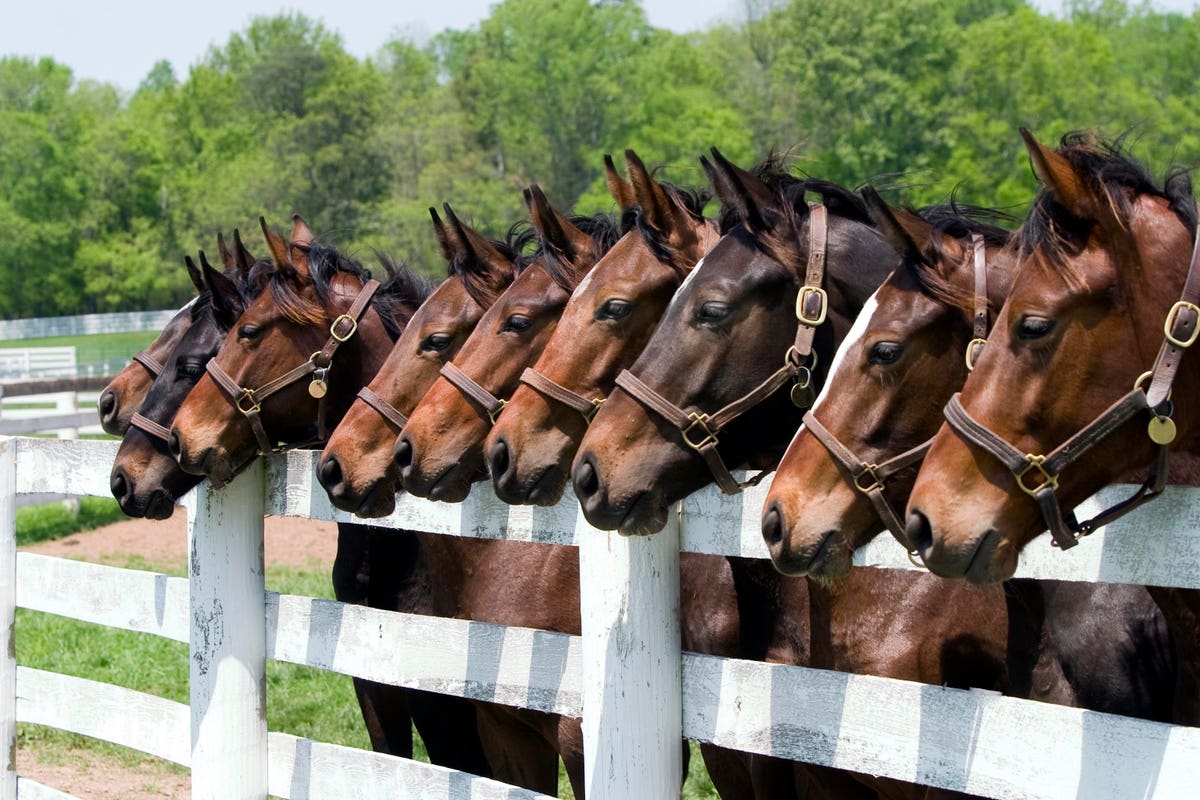
Mark Holmes is noted as being one of the better writers among Tax Court judges. His work on the Estate of Michael Jackson read like a novel. This month he may have gone off the beam a bit in a bench opinion. There is something rather tasteless in bringing up glue factories in the context of thoroughbred horses.
Bench opinions are less formal than memorandum opinions and generally issue more quickly after trial. The case was that of Joseph G. Bucci one of the major owners of American Rock Salt. The company’s product keeps the roadways of the Northeast from being icy all the time in the winter. See The Would-Be Salt Kings of New York City by Adriane Qunlan in New York Magazine.
The stakes were pretty high $711,980 in tax and accuracy penalties for the years 2016 and 2017. It was mostly about Mr. Bucci’s side business of racing and breeding thoroughbred horses. The IRS claimed it was a hobby. Judge Holmes after hearing Mr. Bucci , who represented himself, at trial in Buffalo in June agreed with the IRS.
The Opinion
The opinion reads almost as if Judge Holmes had a friendly chat with Mr. Bucci. He greatly admired his work in founding American Rock Salt which saved his hometown from financial ruin after a multinational abandoned a salt mine, the area’s number one employer, that had flooded. When it came to the heart of the matter, whether Mr. Bucci’s thoroughbred activity was a real business he was pretty hard on him. I have read a lot of hobby loss opinions and horses are a pretty common subject particularly in the bigger dollar cases, but in this one Judge Holmes took a strange almost shocking tack.
“Moreover, it is striking that when I asked him about what he does with the horses that are found not to be capable of racing, he keeps them on the farm More than half the horses, I believe he said aren’t capable of running. They’re not capable of breeding. But he likes the horses, and that’s entirely understandable. He tries to find them, at the end of their career when they become valueless, somebody who will take them on as riding horses or adopt them. He doesn’t just send them to Canada or Mexico for slaughter, which would be a more reasonable economically profitable way of handling horses. It would not be unreasonable for a profit-seeking horse business to keep one or two after their time has gone and, famously, Secretariat was kept on by his owners until he died a natural death. But most horse owners have a more economically slit-eyed view toward things, and if they see a horse that’s not capable of racing and they can’t sell it, they’ll sell it to somebody who will get it up to Canada where there are slaughter houses and glue factories and the like.” (Emphasis added)
It is clear that some horse owners do export for slaughter, which is illegal in the United States, but it is unlikely that it is most. The evidence for that is that major industry players such as the Jockey Club, the Thoroughbred Owners and Breeders Association and the the New York Racing Association have joined with humane societies to lobby Congress to totally ban export for slaughter. The pot of gold at the end of the rainbow for horse owners is to breed the winner who will then have a tremendous value for breeding. This requires cooperating with other owners, who might not want to deal with someone who is sending horses to slaughter.
Not to be nitpicky but according to this article by Megan C. in Horse Rookie, they don’t use them for glue at all anymore. Regardless I don’t think we want the United States Tax Court to be telling thoroughbred owners that they are not being businesslike if they resist the temptation to turn their beloved horses into pet food.
The Other Odd Thing
In this opinion Judge Holmes seems to have ignored a fundamental aspect of Section 183. The Joint Committee Report for the Tax Reform Act of 1969 states that “a reasonable expectation of profit is not required”. The DC Circuit reiterated this in the Dreicer opinion in 1981 in which it scolded the Tax Court for focusing on Dreicer’s expectations of making a profit from his book about the hunt for the perfect steak rather than his objective of making a profit. Judge Holmes seems to do the same thing in this case.
In discussing the business’s potential for appreciation Judge Holmes writes:
“Interestingly enough under the next factor, will the assets appreciate in value over time, this is entirely possible in the case of a horse racing operation. It’s conceivable that one of his horses will win the Kentucky Derby and become nominally profitable. It’s conceivable that somebody will buy a lottery ticket and win the lottery of course. But this is not something that’s ever happened in the tax years at issue.”
Industry Reaction
I spoke with Natalie Voss Editor in Chief of the Paulick Report. Her reaction to Judge Holmes’s comment was extreme surprise. The practice of export for slaughter is not anything approved of in most reputable circles. Reputation is very important in the industry and somebody aiming for the highest levels would be very discouraged from practicing it. And as a practical matter you really don’t get very much out of it. Ms. Voss indicated that as a sort of rule of thumb people will feel confident that a horse is not going to a slaughter broker if it sells for at least $1,000. She also confirmed that they no longer use them to make glue at all.
Ms. Voss did a story on the phenomenon The Kill Pen Economy: Why Is The Slaughter Pipeline So Hard To Shut Off? in 2021. In the story there are others condemning the practice.
“The sale of racehorses to slaughter is a distasteful and inhumane act, and we are vehemently opposed to this practice,” said David Strow, vice president of corporate communications for Boyd Gaming
BYD
Other Coverage
“Lew Taishoff has Out Of The Salt Mine.
“Joe B. loses on all counts, except Judge Holmes is sentimental about octogenarian Joe B’s desire to own a Kentucky Derby winner. So am I, as long as Joe B. doesn’t insist upon us taxpayers paying for it. Joe B earns $8 million per year; he can afford his dream.
There isn’t enough here for me to shout it out to my colleague Peter Reilly, CPA, snapper-up of unconsidered hobby-loss trifles.”
Read the full article here